A Lattice of Union-Finds
Context
Using union-find data-structures is a very efficient way to represent changing sets of equalities or equivalence relations. They render a normally complex computation, the transitive closure, extremely fast. However, to achieve this they suffer from strong limitations. The classical presentation of union-find only allows adding equalities, a process which destroys previous version of the set with fewer equalities. An extension (known as persistent union-find, see Conchon and Filliâtre, A Persistent Union-Find Data Structure, 2007) allows backtracking, i.e. forgetting the most recently added equalities to revert to a previous version.
However, when representing relations in program analysis, such a tree of versions is not sufficient. We want to be able to compare information coming from different control-flow branches, and combine them to obtain the set of equalities that hold after joining such branches. In other words, we need a directed acyclic graph (DAG) of versions, not just a tree. In practice, we propose a lattice, which is more expressive than a DAG, as it has two distinct merges (conjunctions and disjunctions), and allows comparing versions.
Lattice Operations on Union-Find
We formally define the operations required to turn persistent union-find into a lattice:
joincombines two union-finds to only keep the set of equalities that are true in both (i.e. the conjunction of the represented equivalence relations);meetcombines two union-finds to keep the set of equalities that are true in either (i.e. the disjunction of the represented equivalence relations);- an
inclusionoperator allows checking whether a union-find is more precise than another (does it contain all the other’s equalities).
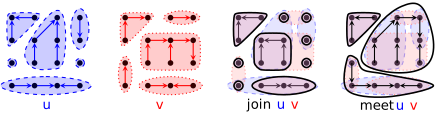
join and meet of union-find structures. Each dot represents a node, each potato a class and each arrow a parent pointer Join Algorithm
We provide fast algorithms to compute all three operations. Our algorithms are remarkably simple, even if they rely on non-trivial correction arguments. Of the three operations, join is the most complex, as it must compute the intersection of all equivalence classes, which creates more classes than there are in either argument. Furthermore, the notion of a class itself is not directly visible in union-find: there are no easily accessible sets of related node. Instead, each node points to a parent, which may be (or transitively point to) the unique representative.
What we realized is that we can identify the classes of the intersection by pairs of representatives from u and v. We can then construct a map new_classes: repr_u * repr_v -> repr_join. Crucially, this map construction is linear, since finding the representatives of a node is an almost-constant time operation:
let linear_join : UF.t -> UF.t -> UF.t = fun u v ->
    let new_classes = Hashtbl.create () in
    let result = ref (UF.make ()) in
    for x in UF.nodes do
        let ru = UF.find u x in
        let rv = UF.find v x in
        match Hashtbl.lookup new_classes (ru,rv) with
        | Some r -> result := UF.union result x r
        | None -> Hashtbl.add new_classes (ru,rv) x
    done;
    !result
This algorithm has complexity where is the total number of nodes and the inverse Ackermann function. It is almost-optimal in the general case, meaning we can find examples where creating the join union-find requires writes.
However, in program analysis, we often join structures that only have small differences. In that case, we want to avoid scanning the entire set of nodes, and only focus on the much smaller set of nodes with differing parents. We can use either Patricia trees (see our OCaml patricia-tree library with faster than linear union and intersection) or persistent array data structures for fast access to that difference set. We can then adapt the above algorithm to take advantage of this diff operator:
let lookup tbl (x,y) =
    if x == y
    then Some x
    else Hashtbl.lookup tbl (x,y)

let diff_join : UF.t -> UF.t -> UF.t = fun u v ->
    let new_classes = Hashtbl.create () in
    (* Create a new pointer to u *)
    let result = ref { parent = u.parent } in
    (* Reset parents of the diff *)
    for x in diff u v do !result.parent[x] <- x done
    (* Proceed as for the linear algorithm *)
    for x in diff u v do
        let ru = UF.find u x in
        let rv = UF.find v x in
        match lookup new_classes (ru,rv) with
        | Some r -> result := UF.union result x r
        | None -> Hashtbl.add new_classes (ru,rv) x
    done;
    result
This new version runs in , which can be considerably faster when is small relative to . Our experimental benchmarks confirm this good performance, for even very large .
Meet and Inclusion Algorithms
Meet and inclusion are considerably simpler, as they can be implemented using the union and find operations directly, and do not require looking deeply at the internals of a union-find structure. Just like join, they also benefit from a difference operator to avoid scanning the entire set of nodes:
let diff_meet : UF.t -> UF.t -> UF.t = fun u v ->
  diff u v
  |> fold (fun result x -> UF.union result x v.parent[x]) u

let diff_incl : UF.t -> UF.t -> bool = fun u v ->
  diff u v
  |> forall (fun x -> UF.find u x = UF.find u v.parent[x])
Both of these run in , and inclusion can early return if an equality that holds in v is not found in u.
Going further
- Read the paper.
- Presented at the Static Analysis Symposium (SAS) 2026 conference, look at the slides.
- Download the software artifact from Zenodo to explore the code and see the performance results, or take a look at the union-find-lattice library that we’ve released on opam.